




Should Jollibee Singapore go plant-based?
Six AI experts argued for 33 messages. Five frontier models were asked separately. They agreed on an answer worth exactly 80 cents, and caught an AI engine getting the halal facts wrong along the way.
One brand. One morning. Every part of our AI infrastructure, tested in public.
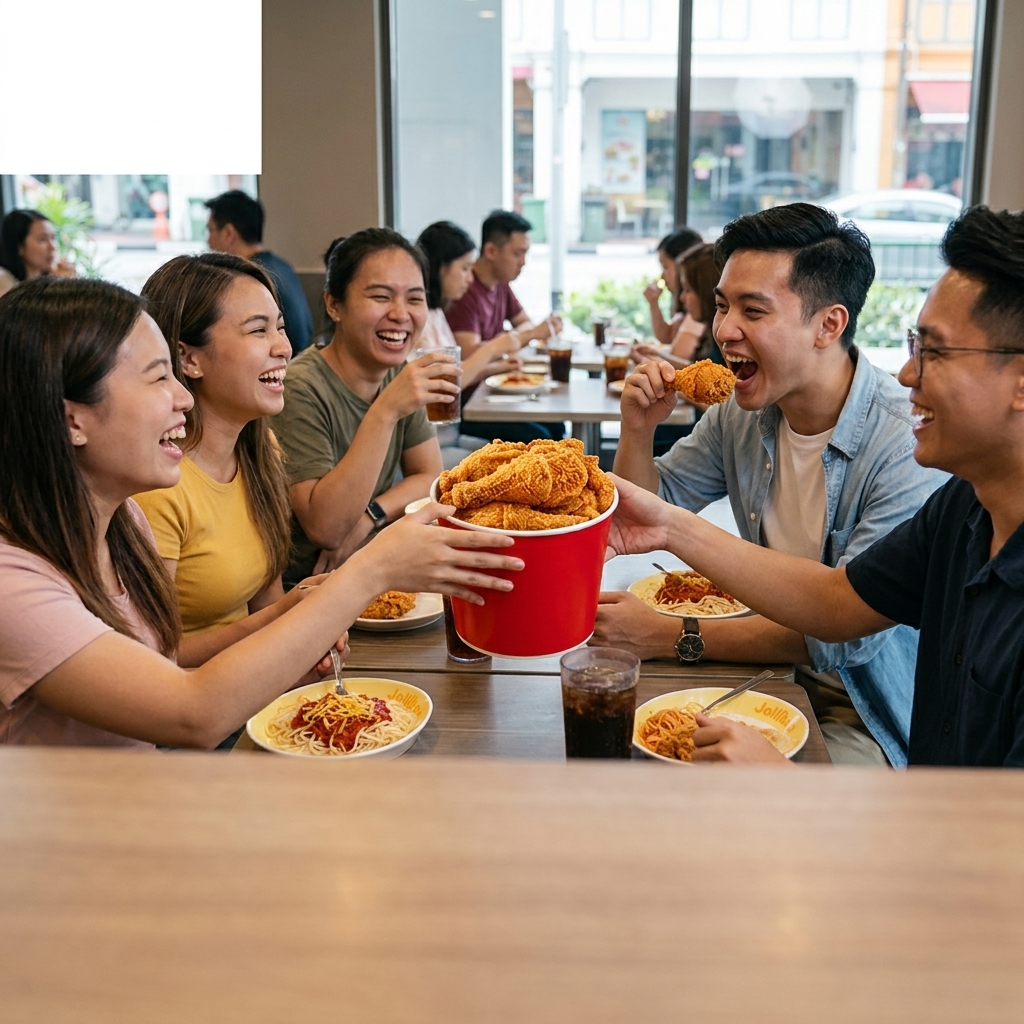
The 60-second version
- The question. Should Jollibee Singapore add plant-based options?
- The answer. Yes, but as an 80-cent opt-in swap inside family bundles. Not a vegetarian menu. Five expert personas argued their way there. Five frontier AI models, asked separately, agreed.
- The surprise. Jollibee is the only major fried-chicken brand in Singapore that people online actually like. Third in share of voice, first in sentiment.
- The problem. One AI engine tells people Jollibee is not halal certified. It is. That error quietly blocks an entire audience.
- The cost. One morning.
Every link below opens the real run. No account needed. The 12-page PDF is here →
Take the whole issue with you
Twelve pages, designed to be read on a train or forwarded to a colleague who will not click through eight sections. Same story, same links, none of the scrolling.
What this is about.
1.1 What we are doing
We build AI infrastructure for marketing teams. Four layers. Every morning we test all four, end to end, to be sure nothing we shipped yesterday broke anything.
A test needs a subject. So each day we pick a brand we admire and run it through everything. Today: Jollibee Singapore, and a question a real marketing team could be sitting on this week.
Today's question
Should they add plant-based options, and if so, how?
There are three ways to drive the platform. Each issue runs through one, so all three get tested in public. Here is what each actually looks like.
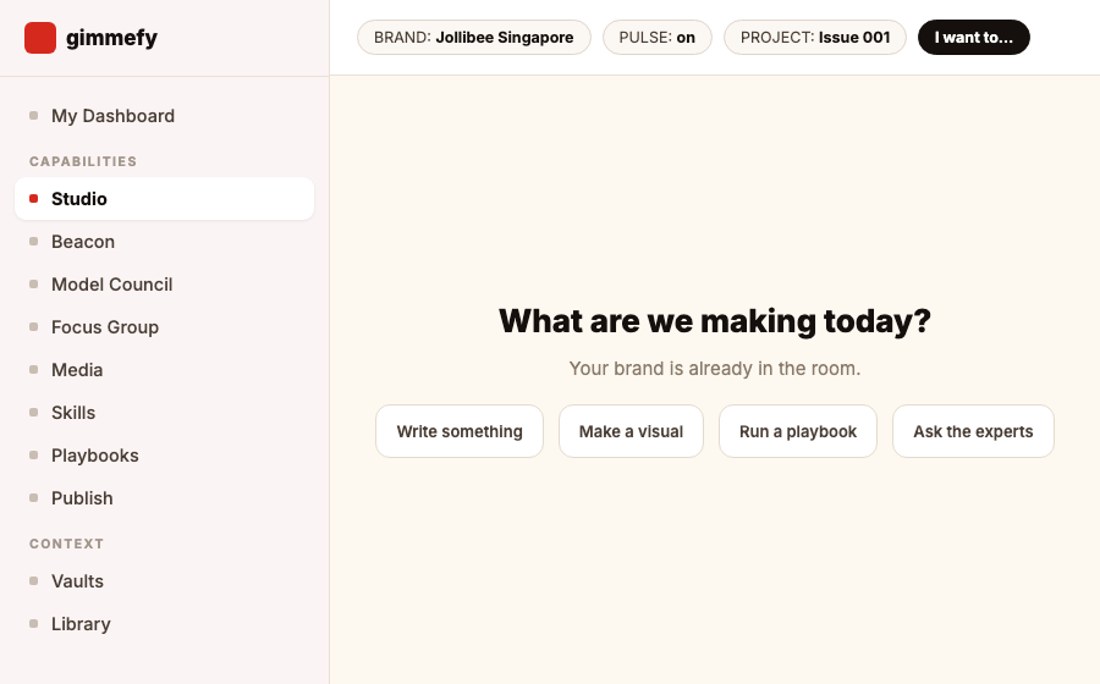
1. The platform
Every capability down the left, your brand context along the top. Pick a tool, brief it, watch it work. Everything in this issue ran here, except the one campaign kit we handed to Friday so you can compare.
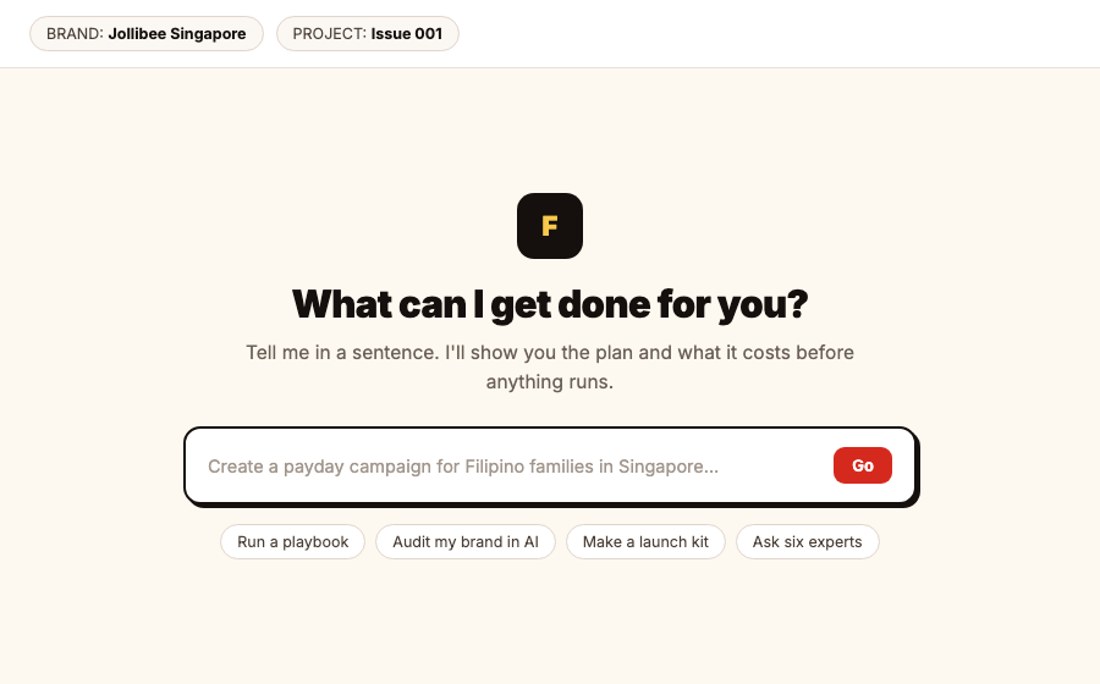
2. Friday
Say what you want in a sentence. Friday reads it, proposes a plan with costs, waits for "Go", then does the work. Used once today, for the payday kit in 6.3.
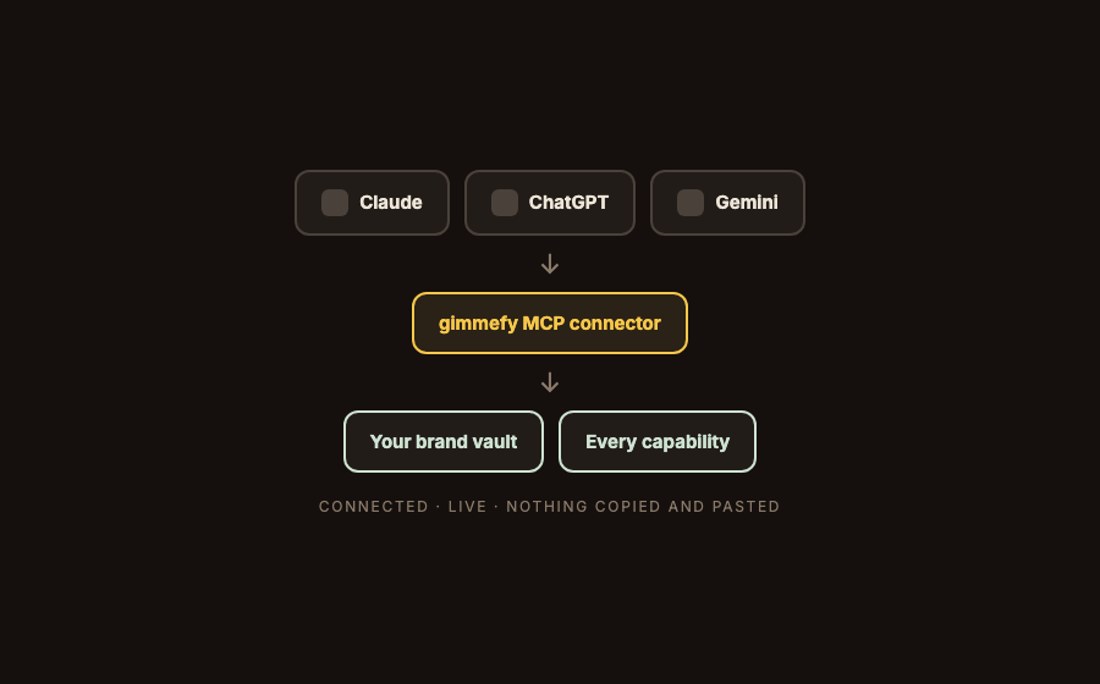
3. MCP
Connect gimmefy inside the AI client you already use. Your vault and every capability, without leaving the chat. Tomorrow's issue runs entirely through this.
1.2 What is in this report
It runs in the order the morning ran. What the machine learned before we asked it anything, what we asked, what came out, the single best piece of work, then the rest of the day capability by capability. Section 7 is how it was built and what broke. Section 8 is every link.
Jollibee is not a client and has not seen this. We picked them because we like the brand and wanted to show what the platform can do. Everything here was generated on gimmefy and is unofficial.
Set-up and discovery.
Before asking the machine to make anything, we ask it to go and learn.
It starts with a brand vault. Think of it as a 360-degree understanding of a business held in one place: who the brand is, how it sounds, what it sells, who it sells to, what it looks like. Not a folder of files. A context layer every capability reads from, so nothing downstream has to be told the brand twice.
Then four environment reports go out and study the brand's world, and their findings fold back into that same vault. Listening reads the public conversation. Search reads what the website earns. GenAI asks the chatbots what they say about the brand. Landscape scores the brand's claims against what the market actually sees. From that point on, every brief, image, debate and campaign in this issue is standing on those four reports.
2.1 Listening
778 public conversations read across seven kinds of source, share of voice measured against every rival, sentiment scored for each.
| Brand | Share of voice | Net sentiment |
|---|---|---|
| McDonald's | 27.2% | −0.16 |
| KFC | 26.3% | −0.23 |
| Jollibee | 20.3% | +0.22 |
| Popeyes | 15.4% | +0.14 |
| Texas Chicken | 10.7% | +0.09 |
The finding
Third in noise. First in affection. The two giants above them are both under water. This brand does not need to buy love. It needs to remove friction.
2.2 Search
The site says all the right things at the speed of a Sunday queue. 150KB of evidence sits behind those five numbers.
See the 150KB of evidence →2.3 GenAI
Five engines asked about the brand: GPT, Claude, Perplexity, Gemini, Grok. Every answer scored against what the brand actually is. Full detail in 6.5, because it turned into the story of the day.
Four engines get the halal question right. One does not.
See what each engine said →2.4 Landscape
In the report's own words: "product superiority actively bottlenecked by operational friction." The food wins. The queue loses.
Read the full landscape read →What we asked it to do.
The platform has more than a hundred things you could run. Picking is the job. We had one decision to serve, so we chose the six capabilities that answer different halves of it, and skipped the rest.
- To understand the market we used Beacon, because it reads what the public and the AI engines actually say.
- To pressure-test the decision we used Focus Group, because stakeholder objections are what kill plans.
- To check the answer was not an accident we used Model Council, which asks several frontier models the same question separately.
- To turn a decision into work we used a Playbook, and to see the fast path we gave Friday one sentence.
- To make it real we used the media capabilities, so there is something you could actually run on Monday.
3.1 · A Maestro
We opened with a strategist persona in Studio and talked the situation through, the way you would with a colleague before writing a brief.
3.2 · One Beacon question
Not "audit us." One question with a decision attached: what do the AI engines tell a hungry person in Singapore, and where does that cost orders?
3.3 · The production factory
Two on-brand images and an 8-second film, vault switched on. We did not run the 50-size resize matrix or a full ad set today. Those are queued.
See the output →3.4 · A workflow
Campaign Creator, our 21-stage playbook, given the payday brief. It became the star of the day.
3.5 · Model Council
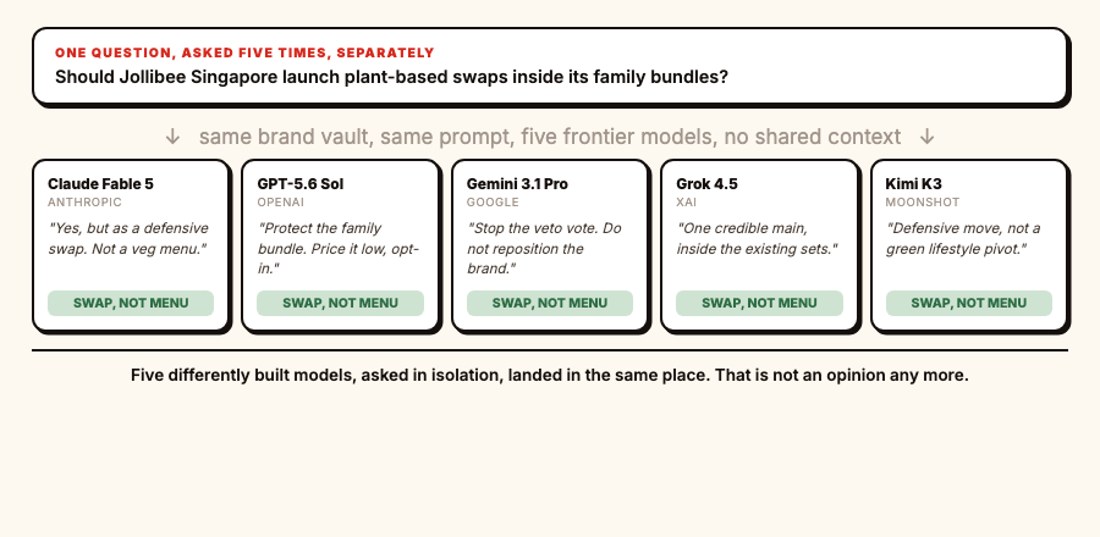
The plant-based question put to five frontier models at once, each grounded in the same brand vault, none seeing the others.
3.6 · One thing we would never have found by hand
The halal error. Nobody at a brand can see what a chatbot says about them in a stranger's private window. So we asked all five, on the record.
The finding →3.7 And then six agents walked into a room
Focus Group takes two things: the experts you pick and the decision you want pressure-tested. We chose six from the roster, each with a different axe to grind: the Brand Strategist, the Consumer Psychologist, the Cultural Strategist, the Data-Driven Strategist, the Growth Hacker and the Product Marketer.
The brief gave them the actual decision, priced and located: two plant-based items as optional swaps inside family meal sets, piloted at NUS, Pasir Ris Mall and Paya Lebar. Inside that brief we described five Singapore customers for them to argue through, from an OFW nurse who wants nothing to change to a vegan blogger who will call out tokenism. Then a facilitator opened the floor and a synthesiser wrote the verdict at the end.
What we got done.
- The recommendation. One plant-based swap inside existing family bundles at a flat 80 cents, opt-in, same price everywhere. Not free, because free eats the margin that funds the value. Not a side dish, because a side dish leaves the problem in place.
- The operational half. A visible five-second halal ritual at the counter. In this market, trust has to be seen to be believed.
- Why it matters commercially. The enemy is not vegetarians. It is the one flexitarian in a family who quietly redirects everyone to a competitor. This is defence of bundles you already sell, which is a very different budget conversation from a green-lifestyle launch.
- The unexpected finding. A major AI engine is telling Muslim diners that a halal-certified restaurant is not halal certified.
- The assets. A finished key visual, an Instagram ad, three captions, a film, and a costed pilot design.
The star today: a campaign built in 21 stages.
One brief in. A complete campaign out, built the way a good agency team builds it, in the same order, before lunch. Read all 21 stages →
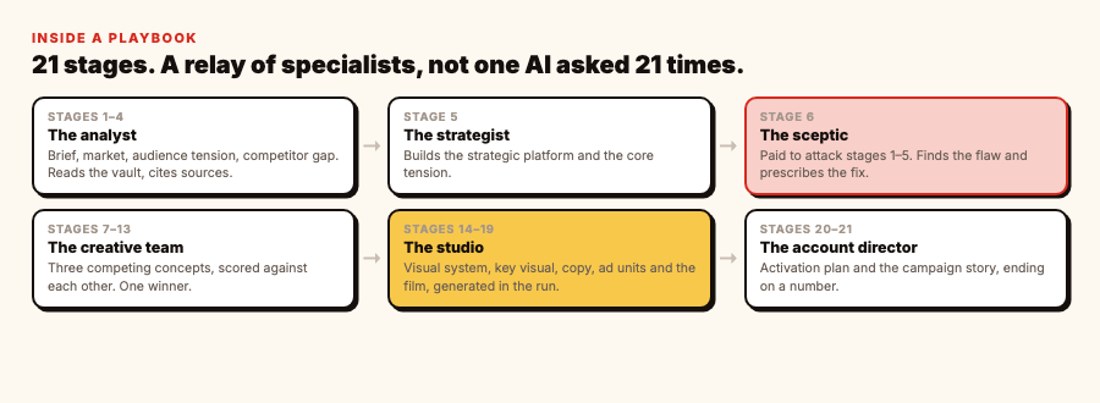
Watch what that structure buys you. Here is stage 12, where the analysis finally becomes an idea.
That line is the campaign. The audience is Filipino workers in Singapore whose salary is spoken for before it lands. Payday is a checklist day, not a spending day. The barrier is guilt, not price. The fear even has a name in the language: luho, reckless spending.
Stage 5 · the tension it found
"People desperately want to celebrate payday as a reward for a month of sacrifice, but the salary is already spoken for by bills and remittances, so treating yourself feels like guilty indulgence rather than a joyful right."
Stage 6 · the machine attacks itself
"Assumes emotional validation will override the need for hard value, yet the brand vault states the USP is value-plus-joy for a price-sensitive audience."
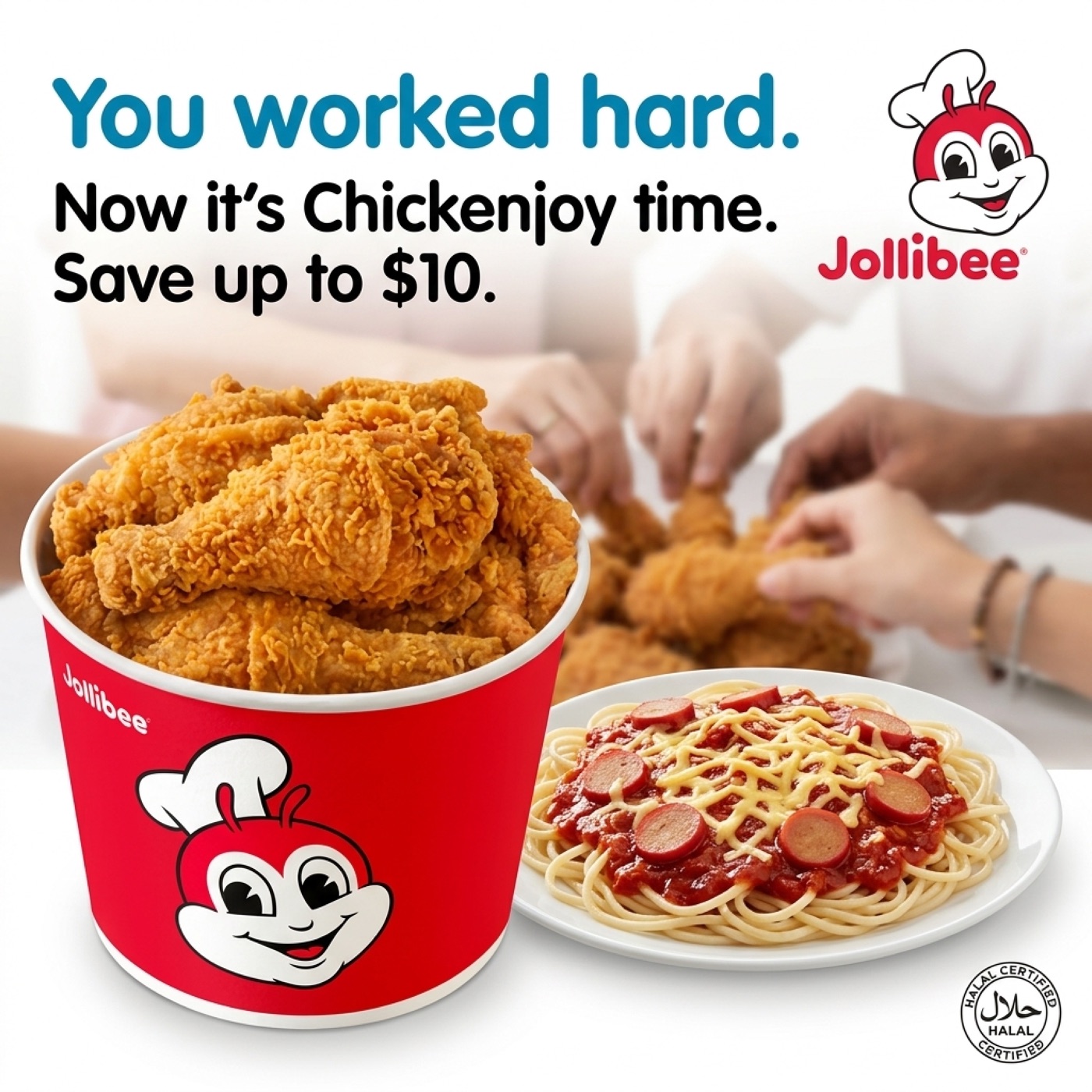
Severity: critical. Fix: keep the emotion, put the $10 saving back in the headline.
What the self-critique changed
Look at the headline on that artwork. "You worked hard. Now it's Chickenjoy time. Save up to $10." That is stage 6's criticism, applied. The machine attacked its own strategy at stage 6, and by stage 15 the fix had made it into the finished creative. Nobody told it to do that.
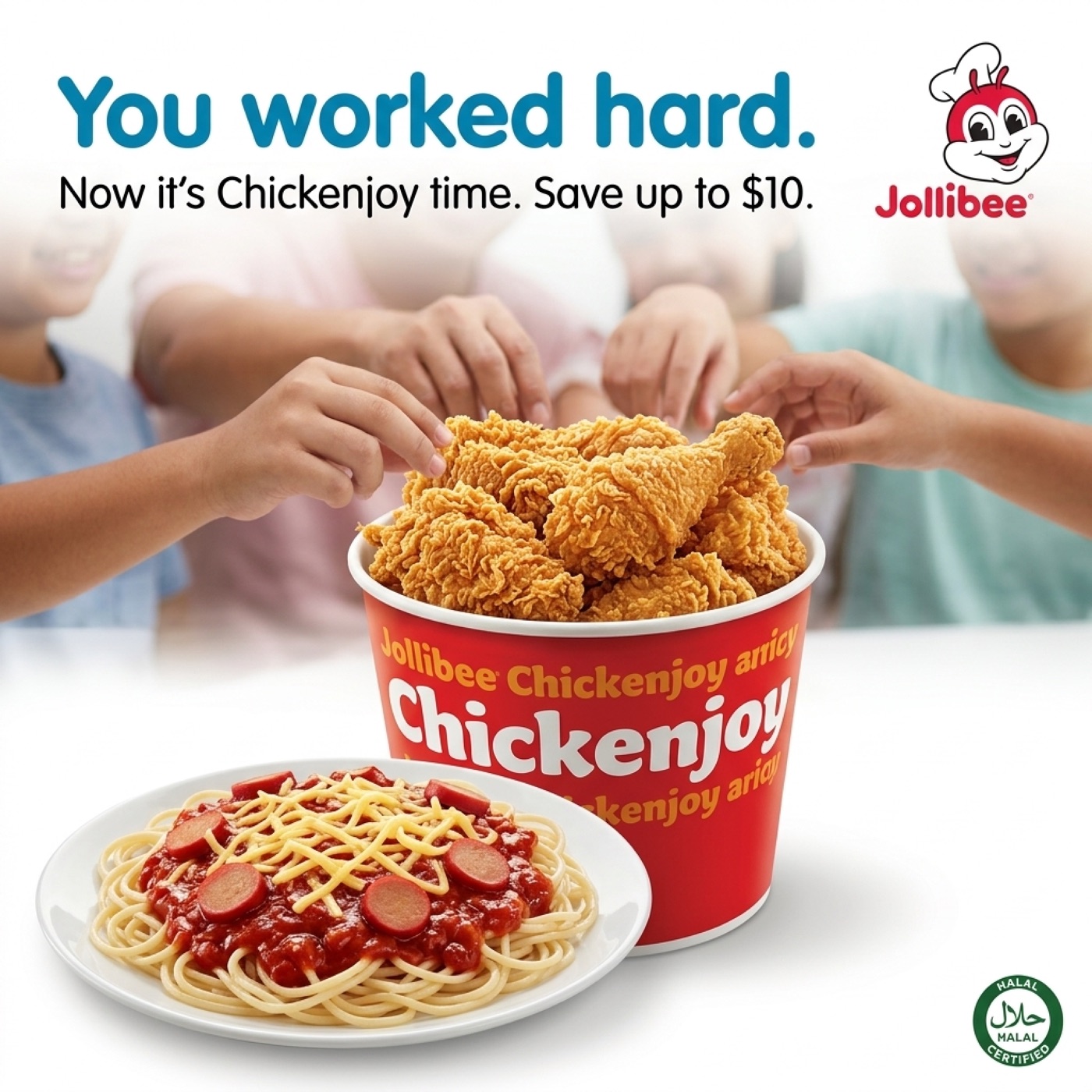
- Stage 16, the copy system. Campaign line: You worked hard. Chickenjoy time. For the OFW audience: Sweldo na. Chickenjoy na. You earned this.
- Stage 19. It generated its own campaign film, mid-run, without being asked twice.
- Stage 21, the number it commits to. Turn an occasional treat into a monthly ritual. Target: a 15 to 20% lift in bucket and family-bundle sales across month-end weekends. Strategy that ends in a forecast rather than a mood board.
Everything else that ran.
The campaign was the star. Here is the rest of the day, in the same shape each time: what we asked, what came back, and why a marketing team would care.
6.1 Focus Group · six agents in a room
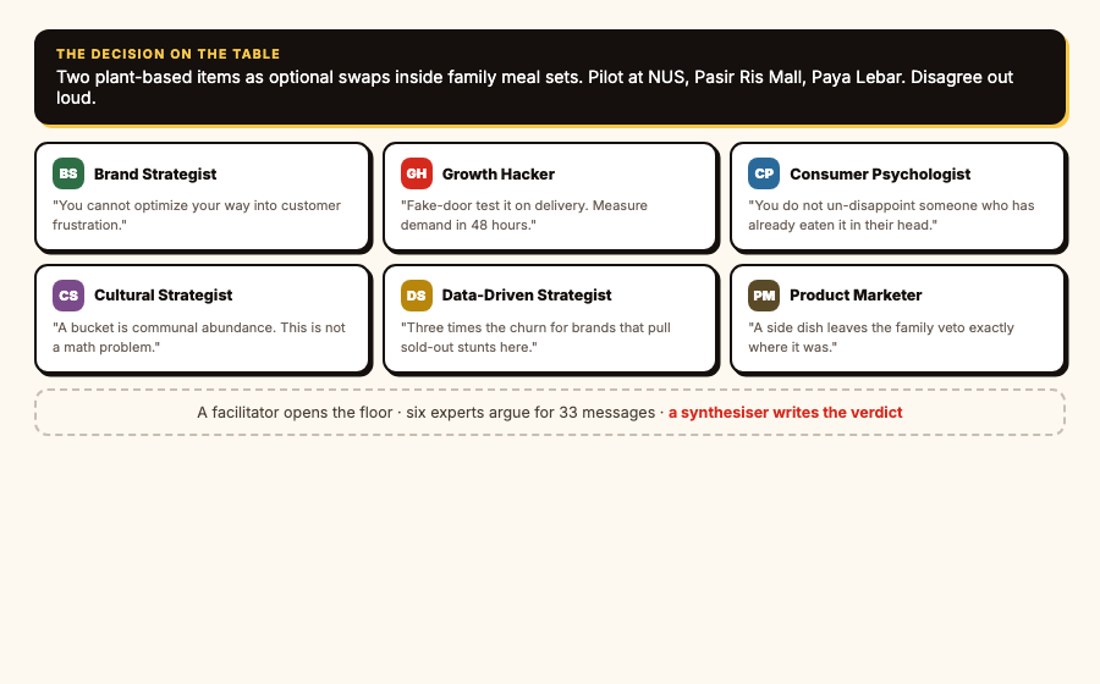
- What we asked. Five customer voices from the vault, named and specific: an OFW nurse, a student flexitarian, a Malay-Muslim mother of three, a value-driven father, a vegan blogger. Debate the plant-based decision, and disagree out loud.
- What came back. 33 messages. A fake-door test proposed and killed. A free swap killed on margin. A $2 side dish killed on what the panel named dietary dignity. Then a verdict with a price on it.
- Why it is useful. You get the objections before the market gives them to you, from people who cannot be talked over in a meeting. Three bad ideas died here for the cost of lunch.
6.2 Model Council · one question, five models
- What we asked. The same plant-based question, sent to five frontier models at once, each grounded in the vault, none able to see the others.
- What came back. Five independent answers that converged: yes to plant-based, no to a vegetarian menu, treat it as defence of the family bundle.
- Why it is useful. A single model always sounds sure. Five models agreeing is the closest a strategy question gets to a measurement, and a disagreement would have been just as useful, earlier.
6.3 Beacon · the AI audit
- What we asked. What do five AI engines tell the public about this brand, and where does it cost orders?
- What came back. Three gaps, each scored and each with a fix attached.
| Dimension | The brand says | The AI says |
|---|---|---|
| Positioning DRIFTED | An everyday family habit. | A nostalgia pilgrimage. An occasional craving with long queues. |
| Proof points CONTRADICTED | Generous portions, save up to $10. | Smaller and pricier per piece than rivals. |
| Audience CONTRADICTED | 100% halal certified. | Four engines agree. One repeatedly says it is not. |
The uncomfortable one
The engine that gets halal wrong is Claude. Which is also the model that wrote this page. We checked. We were wrong. It is in the fix plan. If your brand has a fact that decides who is allowed to buy from you, this is now worth checking every quarter.
- Why it is useful. Nobody at the brand can see this happening. It is a distribution problem disguised as a trivia error, and it is fixable.
6.4 The production factory · images and film
- What we asked. On-brand images for the campaign and a short film, with the brand vault switched on.
- What came back. Two finished images and an 8-second film, plus the campaign's own key visual and Instagram unit from the playbook run.
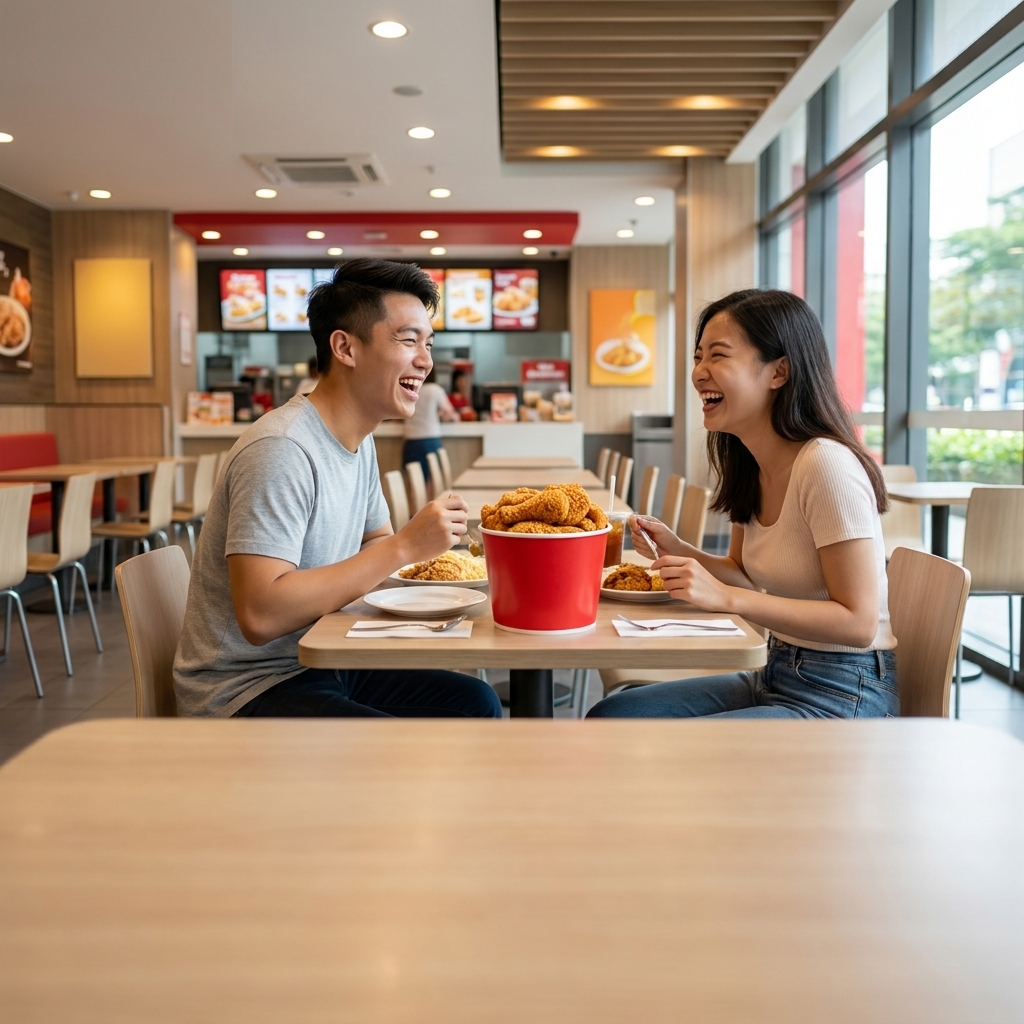

Video Hub, 8 seconds, three frames shown. Play it →
- Why it is useful. Without the vault you get generic fried chicken. With it you get this brand's table, in this city, with the right red. That is the difference between stock and brand, and it is why context is a layer rather than a setting.
- Honest note. We did not run the big jobs today: one visual exploded into 50 sizes, or a full ad set from a single brief. Those are queued for a coming issue.
6.5 Studio and Skills · the quiet workhorses
- What we asked. A strategist conversation to frame the briefs, then a content specialist to write three Instagram captions for the payday moment.
- What came back. The framing that shaped every other brief, and captions carrying the halal line as pride rather than disclaimer, with a day-one checklist for five different roles.
- Why it is useful. This is the ordinary daily work, done in minutes with the brand already in the room. Most teams spend their week here.
How it was built, and what broke.
Everything above was also us checking our own work. The whole point of running a brand through the platform each morning is to find out what is broken before a customer does. Here is what the day cost, how it ran, and what went wrong.
7.1 How the work reached the machine
- Friday. One sentence to a finished kit.
- Direct runs. Studio, Visual Hub, Video Hub, Beacon.
- Playbooks. 103 choreographed stages.
- Multi-agent. One room, agents paid to disagree.
7.2 What broke
- A real gap, found and logged. Images made on the platform get a public share link. Videos do not, yet. That is why the film links to a raw file rather than a proper page. Logged, assigned, being built.
- A rebuild. The first brand vault we made for Jollibee was too thin. We threw it away and built a richer one. Everything above came from the second.
- A small comedy. The Council question went in with two typos, "shoudl I laiunch". All five models answered flawlessly anyway. Nobody mentioned it, which felt polite.
- What we did not run, and will not pretend we did: the 50-size resize matrix, a full ad set, Idea Blitz, Product Innovation Lab. Queued for coming issues.
Appendix: everything, with links.
Every link opens the actual run. No account needed.
Take the whole issue with you
Twelve pages, designed to be read on a train or forwarded to a colleague who will not click through eight sections. Same story, same links, none of the scrolling.
| Listening report | 778 conversations, share of voice, sentiment. Open → Takeaway: third in noise, first in affection. |
| GenAI audit | Five engines interrogated about the brand. Open → Takeaway: one engine is wrong about halal certification. |
| Landscape report | Brand claims scored against market reality. Open → Takeaway: the food wins, the queue loses. |
| Search audit | 150KB of evidence behind five scores. Open → Takeaway: perfect content, slow site. |
| Focus Group | Six agents, 33 messages, decision matrix. Open → Takeaway: the 80-cent swap, and three bad ideas killed before they cost anything. |
| Model Council | Five frontier models, asked separately. Open → Takeaway: total agreement, rarer and more useful than a spread. |
| Campaign Creator | 21 stages, brief to activation plan. Open → Takeaway: stage 6 criticised the strategy and stage 15 fixed it in the artwork. |
| Friday | One sentence to a launch kit. Open → Takeaway: it flagged the queue risk without being asked. |
| Skills | Three captions and a day-one checklist. Open → |
| Studio | The strategist conversation that framed the briefs. Open → |
| Campaign artwork | Master key visual · Instagram unit |
| Visual Hub | Cover image · Gallery image |
| Video Hub | One 8-second film. Play → |
| Longer reads | What five AI engines say about Jollibee · The plant-based verdict in full |
| The whole issue | The Daily Run Nº 001, 12-page PDF |
Tomorrow, a different brand, a different question, the same four layers. The Daily Run →