



SnapStudy.ai refuses to give your child the answer. Six AI models think it does anyway.
Four audits and six expert personas worked one question for a morning. Search told this brand to become an answer engine. The machines said it already was one. The humans said it was the best-loved thing in its category. All three were looking at the same product.
One brand. One morning. Every part of our AI infrastructure, tested in public, including the part that broke.
The 60-second version
- The question. Can an AI homework app win by refusing to give the answer?
- The answer. Yes, but not as currently built. Six expert personas deadlocked three against three, then designed a way out that neither side had proposed: keep withholding the answer, but deliver the clue as a 15-second yes-or-no tap instead of a paragraph.
- The surprise. Its single biggest organic search opportunity is "200 celsius to fahrenheit", 201,000 searches a month. A pure lookup. The exact thing the product refuses to do.
- The problem. Six frontier models were asked to recommend a homework tool. None of them named SnapStudy. Four of its five positioning claims came back marked contradicted, and the machines handed its own differentiator to a competitor.
- The cost. 555 credits and one morning. One capability failed outright and is written up in section 7.
Every link below opens the real run. No account needed. The 12-page PDF is here →
Take the whole issue with you
Twelve pages, designed to be read on a train or forwarded to a colleague who will not click through eight sections. Same story, same links, none of the scrolling.
What this is about.
1.1 What we are doing
We build AI infrastructure for marketing teams. Four layers. Every morning we test all four, end to end, to be sure nothing we shipped yesterday broke anything.
A test needs a subject. So each day we pick a brand we admire and run it through everything. Today: SnapStudy.ai, a camera-first homework app for 10 to 14 year olds, and a question its team could genuinely be sitting on this week.
Today's question
Can an AI homework app win by refusing to give the answer?
It is a real question because the opposite bet just collapsed in public. Chegg sold answers and lost 31 per cent of its subscribers, 30 per cent of its revenue and roughly 99 per cent of its share price to free chatbots. SnapStudy does the reverse. In its own words the AI "provides clues for you so that you can uncover each step of the problem-solving process on your own", and parents and educators set "the level of assistance that child receives". Clues, not answers. Adults hold the dial.
There are three ways to drive the platform. Each issue runs through one, so all three get tested in public. Here is what each actually looks like.
1. The platform
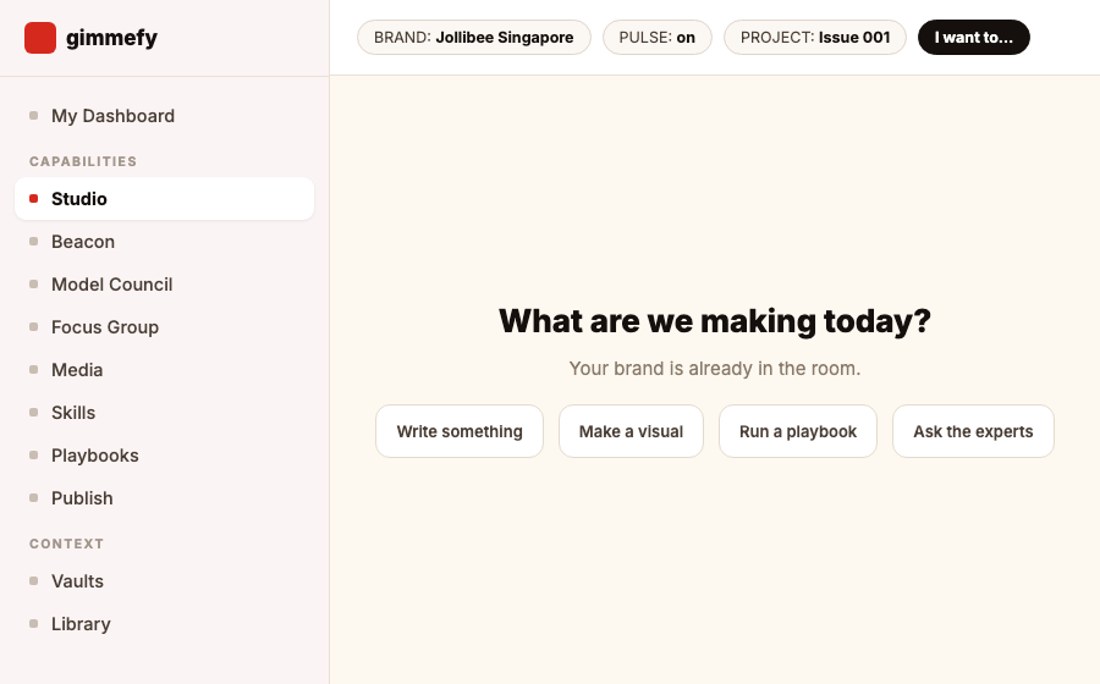
Every capability down the left, your brand context along the top. Pick a tool, brief it, watch it work. Everything in this issue ran here.
2. Friday
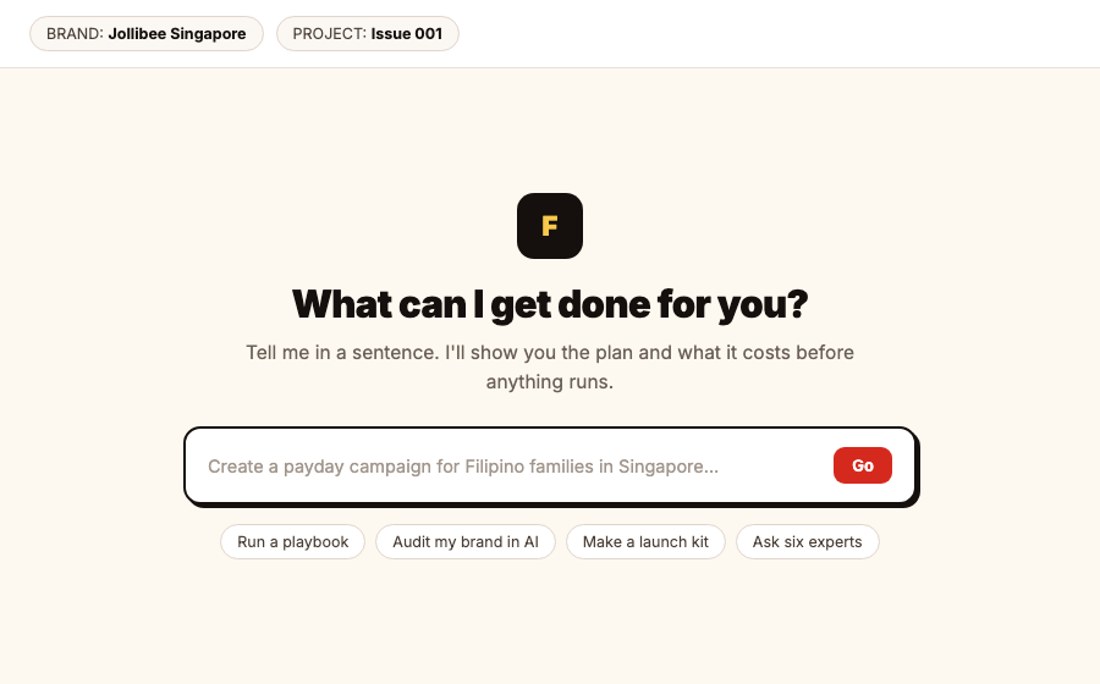
Say what you want in a sentence. Friday reads it, proposes a plan with costs, waits for "Go", then does the work. Scheduled for today and pulled, for the reason in section 7.
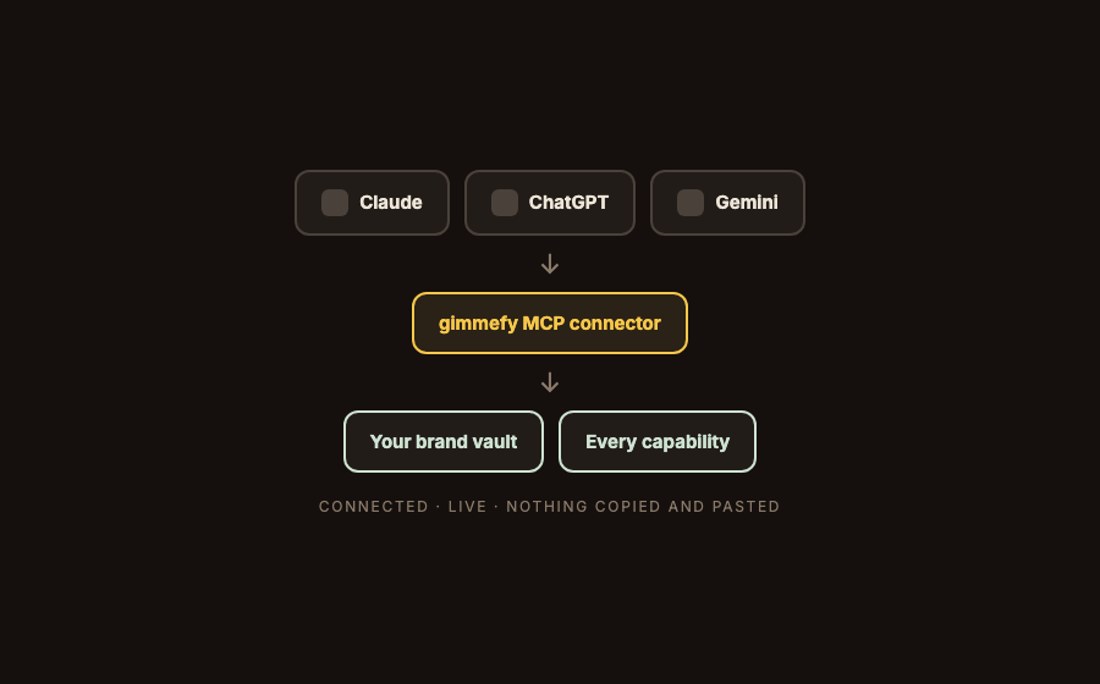
3. MCP
Connect gimmefy inside the AI client you already use. Your vault and every capability, without leaving the chat. Not available on this instance yet, and section 7 says so plainly.
1.2 What is in this report
It runs in the order the morning ran. What the machine learned before we asked it anything, what we asked, what came out, the single best piece of work, then the rest of the day capability by capability. Section 7 is how it was built and what broke. Section 8 is every link.
SnapStudy.ai is not a gimmefy customer and has not seen this. We picked them because the question they face is a genuinely hard one and we wanted to show what the platform does with it. Everything here was generated on gimmefy from public sources and is unofficial. Campaign concepts, forecasts and financial figures are model output, not the brand's real activity or measured results.
Set-up and discovery.
Before asking the machine to make anything, we ask it to go and learn.
It starts with a brand vault. Think of it as a 360-degree understanding of a business held in one place: who the brand is, how it sounds, what it sells, who it sells to, what it looks like. Not a folder of files. A context layer every capability reads from, so nothing downstream has to be told the brand twice. Ours came back with 38 of 38 fields filled and marked grounding-ready, in under two minutes.
Then four environment reports go out and study the brand's world, and their findings fold back into that same vault. Listening reads the public conversation. Search reads what the website earns. GenAI asks the chatbots what they say about the brand. Landscape scores the brand's claims against what the market actually sees.
2.1 Listening
113 pieces of public evidence read across six kinds of source, share of voice measured against every rival, sentiment scored for each.
| Brand | Share of voice | Net sentiment |
|---|---|---|
| Khanmigo | 30.1% | +0.41 |
| Chegg | 29.2% | +0.21 |
| Photomath | 22.1% | +0.32 |
| Socratic by Google | 9.7% | +0.36 |
| SnapStudy.ai | 8.8% | +0.67 |
The finding
Last in awareness. First in affection, by a distance. The people who have actually found this product like it more than anyone likes the market leaders.
Nobody has heard of it. Everybody who has, likes it.
2.2 Search
A live crawl plus keyword, backlink and Lighthouse pulls, scored across five dimensions.
Findability lands at 74 out of 100. Content scores a perfect 100 on 1,183 ranking keywords. Authority scores 33, because the whole site rests on 19 referring domains. And exactly one keyword sits in the top three positions: the brand's own name.
The finding that starts the argument
The two biggest content gaps this audit found are "how many weeks in the year" at 823,000 searches a month and "200 celsius to fahrenheit" at 201,000. Pure lookups. No method to teach, no step to uncover. The search channel is telling a company built on refusing to answer that its largest growth opportunity is to answer.
Thirteen of its fifteen near-miss keywords are definition lookups. The pattern is not an accident.
2.3 GenAI
Six frontier models asked the same buyer questions independently, the first one deliberately never naming the brand.
| Dimension | What the brand says | What the AI says |
|---|---|---|
| Positioning | A guided companion giving step-by-step clues | A "snap-and-solve answer engine that provides full solutions immediately" |
| Proof points | Explicit parent and educator controls | Controls are "essentially nonexistent" |
| Competitive framing | The ethical alternative to answer-vending | Hands that exact differentiator to Khanmigo |
The sentence the whole issue turns on
The company's entire reason for existing is the one thing the machines do not believe about it.
2.4 Landscape
The category, the rivals, and how far the brand's own account of itself sits from the market's.
Positioning clarity is the highest score on the board. Proof is the lowest. The report's own summary of the gap is blunt: the brand "asks parents to pay for a scaffolding tool over a free answer engine, yet reveals zero verifiable proof that students actually learn more."
It also named the vacant ground: SnapStudy sits "in the highly lucrative, vacant middle between Photomath's high-speed cheating risk and Khanmigo's high-friction institutional trust."
Clearest story in the category. Thinnest evidence for it.
What we asked it to do.
Picking is the skill. There are dozens of things the platform can run, and the useful move is choosing the four or five that answer the actual question.
The question was a decision, not a task, so the choices followed from that. Understand the market, use Beacon. Pressure-test the decision with people who disagree, use Focus Group. Turn a decision into work, use a playbook. Make it real, use media. Each brief below had to cite a fact from the reports above, and each carried one hard constraint so we could check afterwards whether the machine actually obeyed it.
The debate
Six expert personas, one decision: hold the line on clues, or drop it. Constraint: no fence-sitting, no "do both", everyone must say "clues, not answers", and they must attack each other by name.
Read the debate →The campaign
A US launch aimed at parents who quietly worry AI is doing their child's homework. Constraint: never use the words cheat or cheating, and make the parent's assistance dial a hero, not a footnote.
What happened to it →The key visual
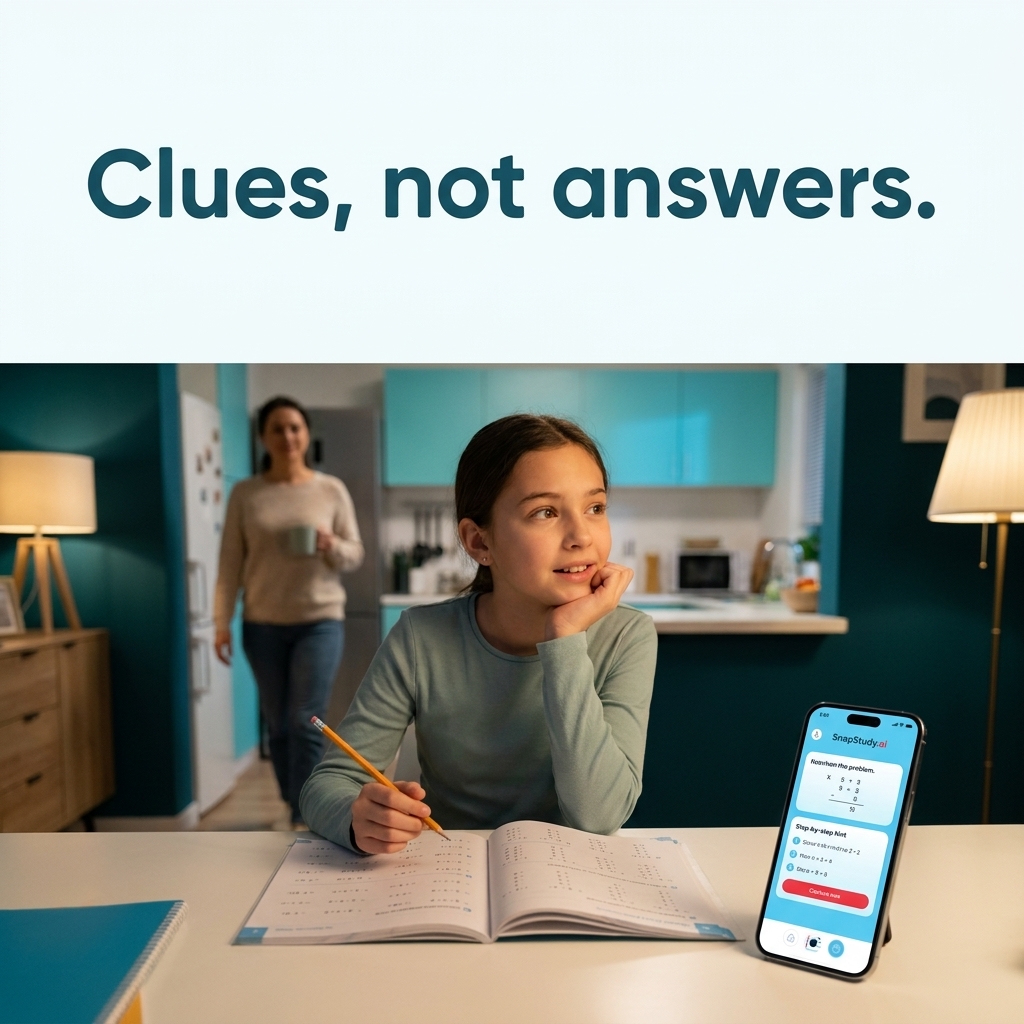
The 9pm kitchen table, the moment before understanding. Constraint: exact on-image text, rendered once, in the brand's own deep teal.
See the visual →What we got done.
- The recommendation. Hold the line on "clues, not answers", and change how the clue is delivered. Not a strategy pivot, a UX one.
- The operational half. The F grade is a metadata problem, not a business-model problem. Publish a governance page and an llms.txt that state the pedagogy in machine-readable terms, and the misclassification has something to correct itself against.
- Why it matters commercially. The buyer and the user are different people. The parent pays for the friction. The child experiences it. Every decision in this category is really about that split.
- The unexpected finding. The search channel wants this brand to become the thing it exists not to be, and it is worth 1,024,000 searches a month to say no.
- Assets produced. One brand vault, four reports, one debate with synthesis and decision matrix, one key visual, two public share links.
The star today: six experts who could not agree.
The best thing the platform produced today was not an asset. It was an argument that refused to resolve, and then resolved itself in a way nobody in the room had proposed.
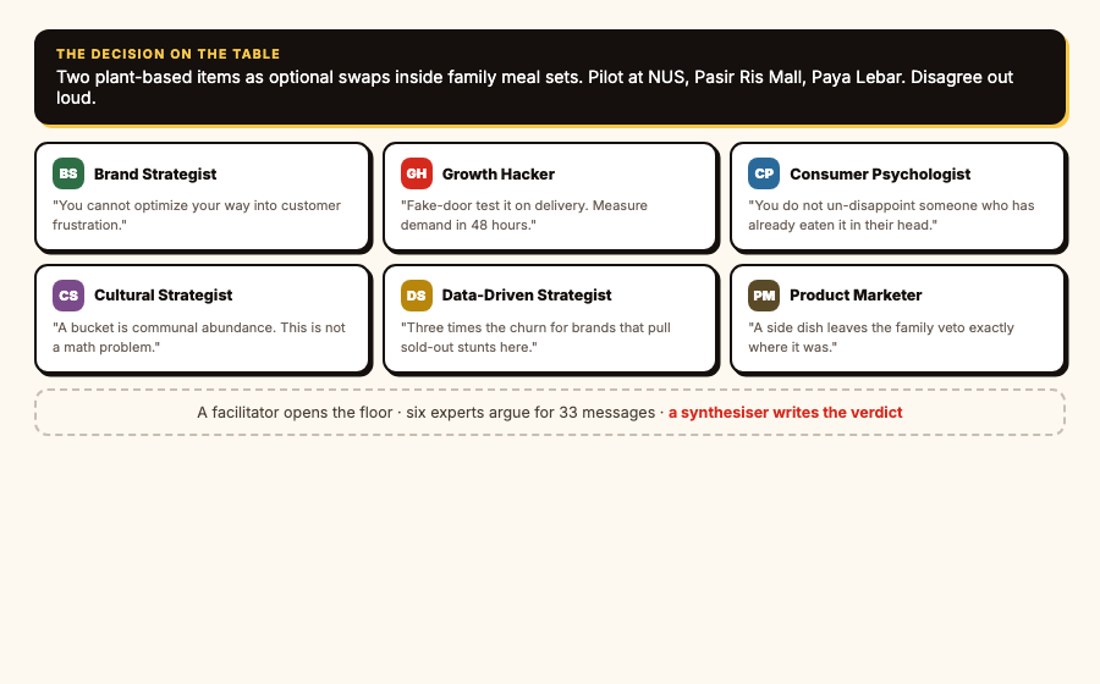
We picked six lenses that map to the people who really decide this: the CEO, a CFO, a cultural strategist, a devil's advocate, a consumer psychologist and a UX strategist. Five rounds, observer mode. The brief agent sharpened our question before it went to the room, and its version was better than ours:
5.1 They split three against three
The fault line is the interesting part. The three who think about the buyer said hold. The three who think about the user said drop.
5.2 Then it designed a third option
The synthesis rejected both opening positions and approved something neither camp had put on the table.
| Option | Verdict |
|---|---|
| Pivot to answer engine | Rejected. "The exact path that vaporized Chegg's market cap." |
| Hold the line, current UX | Rejected. "The positioning is correct, but the execution is fatal." |
| Hold the line, progressive disclosure UX | Approved. "The only path that satisfies both the exhausted student and the paying parent." |
Reveal number one
Keep refusing the answer. Change the shape of the clue. Replace a paragraph of Socratic prose with a 15-second binary tap, "did you simplify this fraction first?", so the tired child gets momentum without ever being handed the destination.
It also produced the most useful reframe of the morning, which costs nothing to act on: the F grade is "a content indexing bug, not a business model flaw." Fix the schema, not the strategy.
Watch all six argue it out →5.3 And then it attacked our own headline
We led this issue on "last in awareness, first in affection". The devil's advocate turned that straight back on us.
Reveal number two
Our two best findings might be one finding wearing two hats. We have left both in, next to each other, because that is the honest position and because the machine caught it before we did.
Everything else that ran.
6.1 The brand vault
What we asked. Build a 360 of SnapStudy.ai from its public site and nothing else.
What came back. 38 of 38 fields, 98 per cent complete, marked grounding-ready, in under two minutes, with 13 visual assets found on the site. It independently landed on the framing that matters: "unlike many homework-help brands framed as answer engines, SnapStudy.ai consistently markets itself as a guided learning companion."
Why it is useful. Everything downstream reads from it. The debate above argues about this brand specifically because the vault told it who this brand is.
6.2 The key visual
What we asked. The 9pm kitchen table, the moment before understanding, parent deliberately walking away, with one exact line of on-image text.
What came back. The image at the top of this page, first attempt, five credits, with the line rendered correctly in the brand's own deep teal.
Why it is useful. On-image text is where most image models fall over. Specifying it exactly, once, in a named colour, is the difference between an asset and a redraw.
Open the visual →6.3 The campaign that did not finish
What we asked. A full US launch campaign, 21 stages, with two banned words and a mandated hero mechanic.
What came back. Seven stages of genuinely good strategy, then a wall. The brief, three intelligence stages and three strategy stages completed. It named the campaign "Clues, Not Answers" and wrote the line the whole thing hangs on:
Our hard constraint survived all seven stages word for word, which is the thing we were actually testing: "never use the words cheat or cheating", "the assistance dial must be shown and named as a hero mechanic", "zero claims about measured learning outcomes".
Why it is useful anyway. A playbook that fails at stage 10 still leaves you seven stages of work. Section 7 has what broke and why.
How it was built, and what broke.
Everything ran on the platform surface, inside one project, on a white-labelled instance of our own. The vault was built from the public website only. That last point matters more than it sounds: this subject reached our attention through a partner's account, and we deliberately did not read a single thing from it. It is the only reason the line "not a customer" at the top of this page is true.
7.1 The gap we found and logged
- The campaign died and stayed dead. Every creative stage needs a key visual, none could be produced, and three resume attempts failed identically. Logged against an existing critical ticket. The same image model works perfectly on its own, which is how we know it is the playbook's media path and not image generation.
- Two browser tabs held two different projects at once. Same account, same session. Work submitted from the stale tab would have filed itself into yesterday's project with no warning. Caught before the debate ran.
- The bulk report refresh ignored its first click, then did not repaint when the reports finished. We only knew they were done because we went looking in the database.
7.2 The thing that made us wince
The debate synthesis is beautifully argued and its financial spine is entirely invented. None of these came from us, from the vault, or from any source, because SnapStudy's pricing, costs and churn are all private:
- $270 lifetime value on a $15 a month subscription
- Parent churn rising 3% to 12%
- GPU cost falling $0.08 to $0.03 a session, expanding margin to 84%
The auto-generated infographic brief then promoted two of those inventions to headline statistics. This is not an argument against the tool. It is a precise description of where the human belongs: the reasoning holds up, and every number needs checking before it leaves the building.
The lesson we are keeping
Print the strategy. Strike the arithmetic. Say why.
7.3 One thing that made us laugh
We filed a bug accusing the platform of running three of four reports. It had run all four. The fourth simply uses a different executor and was invisible where we went looking. We rewrote the ticket with the retraction attached and downgraded it, which is roughly what we would want anyone else to do.
7.4 What we did not run
Model Council, video and staged publishing did not run today. The Daily Run's own instance has no MCP endpoint yet, so nothing in this issue was made through the connector and we are not going to pretend otherwise. Today's stamp says PARTIAL for that reason.
Appendix: everything, with links.
| Listening report | Last of five in share of voice at 8.8%, first of five in net sentiment at +0.67. Open the report → |
| Search audit | Findability 74 of 100. Authority 33 on 19 referring domains. The answer-query contradiction. Open the report → |
| GenAI audit | Grade F, 31 of 100, 0% share of AI voice, four of five claims contradicted. Open the report → |
| Landscape report | B minus, 65 of 100. Positioning clarity 85, efficacy proof 30. Open the report → |
| The debate | Six experts, split three against three, synthesis approved a third option neither camp proposed. Read the debate → |
| Key visual | "Clues, not answers", generated first time with exact on-image text. See the visual → |
| The PDF | Twelve pages, the whole issue, designed to be forwarded. Download → |
The whole issue, twelve pages
Everything above, laid out to read on a train or forward to someone who will not click through eight sections.
Made on gimmefy: Brand Vault, Beacon (Findability, GenAI, Listening, Landscape), Focus Group, Visual Hub. Run on a white-labelled instance of our own, which is the same platform wearing our brand. MCP included: use gimmefy context and capabilities from ChatGPT, Claude, Gemini or any compatible AI client.
SnapStudy.ai is not a gimmefy customer and has not seen this. We picked them because the question they face is a genuinely hard one and we wanted to show what the platform does with it. Everything here was generated on gimmefy from public sources and is unofficial.